
Huawei Unveils DriveONE “ZhIQing” and Megawatt Charging Strategy to Transform EV Industry
Ahead of the 2026 Beijing Auto Show, Huawei has already captured industry attention with a major announcement. At a pre-show conference, Hou Jinlong, President of Huawei Digital Energy, introduced the new Chinese branding for Huawei DriveONE — “Huawei ZhIQing” — along with an upgraded ultra-fast charging strategy covering both passenger and commercial vehicles.
This move signals a new phase in China’s rapidly evolving electric vehicle (EV) market.
A New Phase for China’s EV Industry
After more than a decade of development, China’s EV sector has moved beyond policy-driven growth and mass adoption. The industry is now entering a third wave defined by:
- Higher quality standards
- Full-scenario electrification
- Global competition
While passenger EV adoption has surpassed 50%, commercial vehicles — especially heavy-duty trucks — still face major electrification barriers. Huawei aims to change that.
Huawei ZhIQing: From Components to Full-System Integration
Traditionally, EV development has focused on replacing key components:
- Engine → Electric motor
- Fuel tank → Battery
- ECU → Electronic control
But Huawei argues this approach is no longer sufficient.
With advanced autonomous driving approaching large-scale Level 3 deployment, Hou Jinlong highlights a critical gap: true electrification must extend beyond propulsion.
Huawei ZhIQing introduces a fully integrated “motion domain” system that combines:
- Drive
- Braking
- Steering
- Suspension
into a unified control architecture.
This system-level approach delivers:
- 50% faster response times
- 50% higher control precision
- Improved safety and driving experience

Breakthrough Efficiency and Performance
Huawei’s new silicon carbide dual-motor platform achieves over 94% efficiency in both range-extender and pure electric modes.
Key highlights:
- Up to 12 km per kWh efficiency
- Brake response reduced to 78 milliseconds
- Advanced XYZ-axis control model for real-time coordination
As of April 2026:
- Over 2.4 million DriveONE units shipped
- More than 40 billion kilometers driven globally
Huawei aims to position ZhIQing as a benchmark for safety and reliability in EV systems.
Megawatt Charging: Solving the Electric Truck Challenge
While ZhIQing improves vehicle performance, Huawei’s megawatt charging strategy tackles one of the biggest bottlenecks in EV adoption — charging infrastructure.
Heavy-duty trucks represent:
- Only 3% of vehicles
- But 54% of road transport emissions
Despite this, electrification has been limited due to slow charging and infrastructure gaps.
From Slow Charging to Megawatt Power
Traditional charging for trucks can take over an hour for 300–400 km of range — far too slow for logistics operations.
Huawei’s solution:
- Megawatt-level charging systems
- Support for 1C to 3.5C+ batteries
- Full ecosystem integration (OEMs, battery makers, operators)
By 2026:
- Charging networks cover 400+ cities in China
- Over 100 truck models will support megawatt charging
Lower Costs, Higher Efficiency
Huawei estimates significant cost savings:
- Diesel truck: ~0.37–0.39 USD per km
- Electric truck (Huawei system): ~0.16–0.21 USD per km
This reduces logistics costs while improving operator profitability.
Smart Charging Meets Smart Grid
High-power charging introduces challenges for electrical grids. Huawei addresses this by turning each charging station into a microgrid system, enabling:
- Better grid integration
- Energy storage management
- Safer high-current charging (up to 2400A)

Building an Open EV Ecosystem
Huawei emphasizes collaboration over competition.
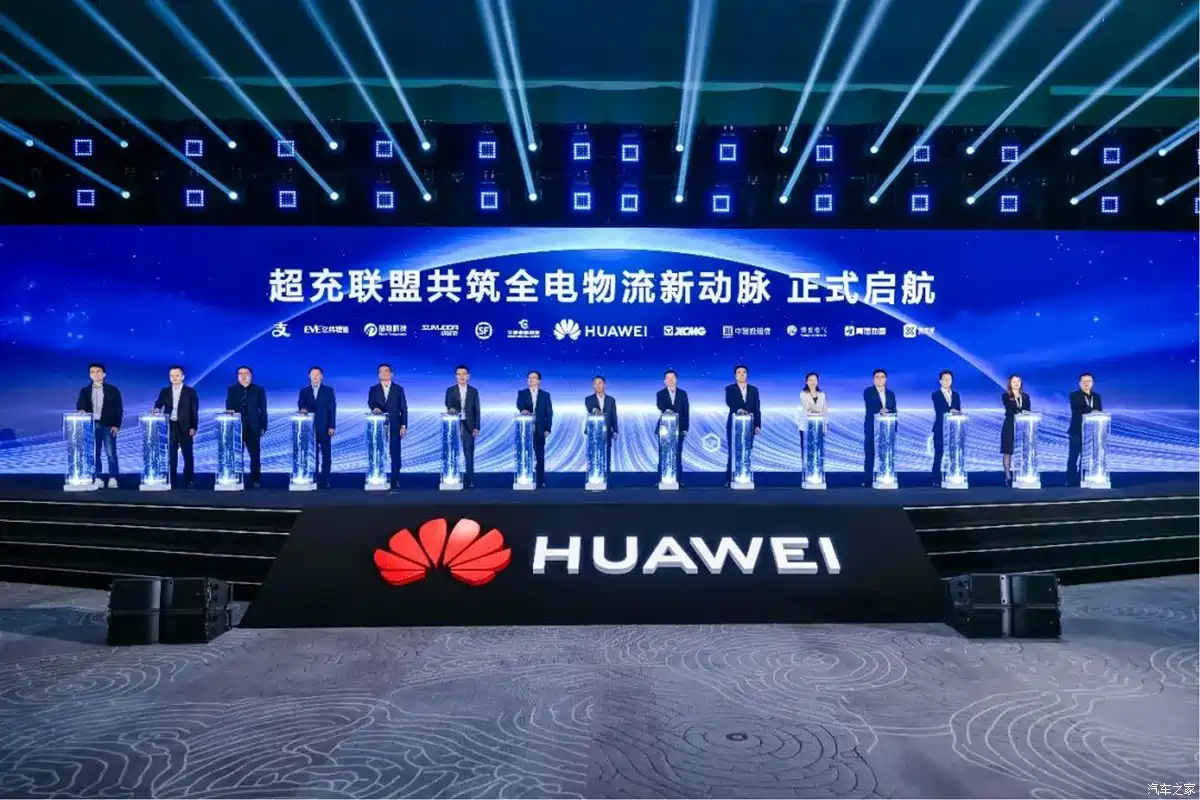
Its supercharging alliance, launched in 2024, now includes:
- Commercial vehicle manufacturers
- Battery suppliers
- Charging operators
- Logistics companies
The goal: eliminate fragmentation and create a unified charging standard where any compatible vehicle can access optimal charging anywhere.
Competing on Technology, Not Just Cost
As global EV competition intensifies, Huawei believes the future will be defined by:
- Technological innovation
- Ecosystem collaboration
- Global standard leadership
Rather than competing on price alone, Huawei focuses on:
- Safety
- Performance
- System-level efficiency
Conclusion
With the launch of Huawei ZhIQing and its megawatt charging ecosystem, Huawei is positioning itself as a key enabler of next-generation electric mobility.
By addressing both vehicle intelligence and charging infrastructure, the company is helping unlock new growth opportunities — especially in commercial transport.
As the third wave of the EV revolution unfolds, Huawei’s integrated approach could play a decisive role in shaping the global electric vehicle landscape.

