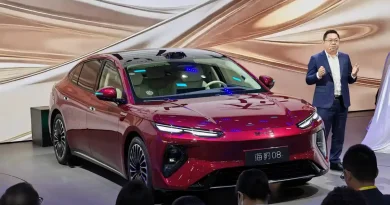
BYD Da Han Review: Complete Guide to Price, 1,008 km Range, Specs and Features
BYD Da Han EV is the brand’s new flagship large sedan, and it is built around one promise: luxury, comfort and record-setting range at a price that mainstream buyers can reach. Set to go on sale in China on October 13, 2026, the Da Han EV carries a pre-sale price of ¥249,900–299,900 (about $37,200–44,700) and a maximum CLTC range of 1,008 km. Until now, the cheapest new-energy large sedan in China started above ¥600,000 (about $89,400).

BYD is pushing into this segment while its domestic market faces tougher competition, even as overseas expansion keeps total sales growing year on year. The Da Han EV is the next step: a new, more specialised niche rather than another entry in the price war.
BYD Da Han EV Price: Large Sedan Enters the ¥200,000–300,000 Bracket
The pre-sale range of ¥249,900–299,900 ($37,200–44,700) puts the Da Han EV within reach of buyers who previously could only look at mid-size sedans in this price band. The final launch price, due October 13, is expected to be more attractive still.

For context, the smaller BYD Seal 08, a mid-to-large sedan, is priced at ¥196,900–239,900 ($29,300–35,800). Its sales topped 6,000 units (6,038) in its second month on sale, making it the best-selling mid-to-large model in the ¥200,000–300,000 bracket after the Xiaomi SU7. The Da Han EV is only slightly larger, which allows BYD to avoid internal competition between its Dynasty and Ocean networks.
At the top of the market, models such as the Zunjie S800 have set the benchmark for Chinese large sedans, but with prices around ¥1,000,000 (about $149,000) they are out of reach for most buyers.


From Han EV to Da Han: Why BYD Keeps Betting on the Han Name
The Han has long been BYD’s spearhead in the premium segment. The 2020 Han EV was the first car to use the Blade Battery and the dedicated e-Platform, delivering 605 km of NEDC range and 0–100 km/h in 3.9 seconds. Its design and spacious cabin reshaped how buyers saw the brand.
Lessons From the Seal and Han L
The Seal, launched in 2022 on e-Platform 3.0 with CTB battery-body integration and a double-wishbone front, five-link rear suspension, did not unseat the Han. Buyers stayed loyal to the Han’s comfort-first character.
The same happened in 2025 with the Han L, the first Han on the new Super e-Platform with 1,000 V architecture, 10C charging and up to 810 kW in dual-motor form, 0–100 km/h in 2.7 seconds and a 270 km/h top speed. Customers still gravitated to the better-value older Han. The Da Han EV applies that lesson: less spec-sheet excess, more comfort and value.


BYD Da Han EV Range and Charging: 1,008 km and 9-Minute Flash Charging
Range and charging speed are where BYD concentrated its engineering on the Da Han EV.
Battery and range
- Battery: 102.3 kWh lithium iron phosphate (LFP), second-generation Blade Battery
- Two-wheel-drive version: up to 1,008 km CLTC, 11.5 kWh/100 km
- All-wheel-drive version: 880 km CLTC, 13.1 kWh/100 km
- Drag coefficient: 0.197 Cd, lower than many mainstream large sedans
At 11.5 kWh/100 km, the Da Han EV rivals the most efficient cars in the class: the Tesla Model 3 (as low as 11 kWh/100 km) and the Xiaomi SU7 (as low as 11.7 kWh/100 km).
Flash charging
BYD flash charging takes the battery from 10% to 97% in just 9 minutes, and only about 3 minutes longer at –30°C. BYD’s large-scale rollout of flash-charging stations in China this year supports the feature.
BYD Da Han EV Performance and Specs
To keep the price down, BYD did not fit the Han L’s super motors. Even so, the dual-motor Da Han EV sprints from 0 to 100 km/h in 3.3 seconds, and the top speed is 270 km/h, ample for a car focused on comfort rather than track driving.
| Specification | BYD Da Han EV |
| Launch date (China) | October 13, 2026 |
| Pre-sale price | ¥249,900–299,900 (~$37,200–44,700) |
| Body type | Large electric sedan |
| Length / width / height | 5,256 / 1,999 / 1,510 mm |
| Wheelbase | 3,130 mm |
| Single-motor version | 370 kW, 500 N·m, 0–100 km/h in 4.9 s |
| Dual-motor version | 570 kW, 910 N·m, 0–100 km/h in 3.3 s |
| Top speed | 270 km/h |
| Battery | 102.3 kWh LFP, 2nd-gen Blade Battery |
| CLTC range | 1,008 km (two-wheel drive) / 880 km (all-wheel drive) |
| Energy consumption | 11.5 kWh/100 km / 13.1 kWh/100 km |
| Fast charging | 10–97% in 9 minutes (+3 min at –30°C) |
| Suspension | Yunnian-A (DiSus-A) dual-chamber air suspension with preview, 100 mm adjustment |
| Turning radius | 4.95 m (rear-wheel steering) |
| Wheels | 20 and 21 inches |
| Driver assistance | God’s Eye 5.0 with urban-assist and auto-parking fallback |
BYD Da Han EV Exterior Design
The Da Han EV keeps the Han family’s signature look but adds a more premium finish. The classic front and rear light signatures return, now more refined.
Front and side
A clamshell hood opens to a front trunk of about 130 litres. The headlights are joined by a 2.41-metre one-piece daytime running light that meets the central Han badge. Air channels in the lower bumper add sportiness, while the flat, wide nose gives the car presence.
In profile, a clean line, cut-surface window sills, short overhangs and a 3,130 mm wheelbase make the car look long and wide while freeing up cabin space. Rear-wheel steering cuts the turning radius to 4.95 m, easing manoeuvring for a 5.26-metre sedan.
Wheels, doors and rear
Buyers can pick 20- or 21-inch wheels in disc or multi-spoke styles, topped with floating wheel badges, a feature usually reserved for ultra-luxury cars. Semi-concealed door handles and four electrically closing doors complete the look.
At the rear, 3D feather-style through-light taillamps and a high, sculpted waistline give a sports-car touch. A panoramic roof extends to the rear window with an electric sunshade, and rear passengers get switchable privacy glass.
Colours
Five single-tone colours are offered: Qianshan Green (the classic Han EV shade), Chidi Red, Obsidian Black, Xinghan Silver and Yunhai Beige. Four two-tone options are also available: Xinghan Silver/Black, Yunhai Beige/Black, Chidi Red/Silver and Qianshan Green/Silver.


BYD Da Han EV Interior and Technology
Inside, BYD dropped excess ornamentation in favour of a minimalist layout that relies on high-grade materials and fine detail. The dashboard still echoes the Dynasty family’s angular, roof-line-inspired design.
Materials and screens
The cabin introduces a new white-grain real wood trim, with chrome ambient lighting, suede headliner, chrome accents and a selectable fragrance system. The new two-tone, three-spoke steering wheel keeps the look clean.
There are three screens up front, led by a floating 17.3-inch 3K central display. The DiLink 300 smart cockpit (advanced version) includes an AI assistant that can control multiple functions by natural voice and remember user preferences. Audio comes from a 31-speaker Devialet 7.1.4 system, including four headrest speakers.
Seats and space
Nappa leather seats are standard, with dual zero-gravity front seats offering electric thigh support, heating, ventilation and massage. Rear passengers get dual electric leg rests, a right-rear “boss” footrest and seat angle adjustment over a 12-degree range. The rear centre armrest houses a touch-control panel, with a folding rear screen and table; a PAD screen can be added.
In all, the Da Han EV offers 46 storage spaces, including a password-protected glovebox and a side-opening cooling-and-heating box that operates from –6°C to 50°C.


Standard Equipment on Every BYD Da Han EV
BYD confirmed that all trims will include the following, so even the entry model gets the 1,008 km range:
- Yunnian-A air suspension
- Flash charging
- Rear-wheel steering
- God’s Eye 5.0 driver assistance
- 17.3-inch 3K central screen
- Nappa leather seats
- Dual zero-gravity front seats
- Devialet audio
- Electrically closing doors
- Rear folding table


Who Is the BYD Da Han EV For?
Most popular sedans in the ¥200,000–300,000 bracket, including the Tesla Model 3, Xiaomi SU7, Zeekr 007GT, Shangjie Z7 and Lynk & Co 10, lean towards sporty handling. The Da Han EV goes the other way: large-sedan luxury and comfort, with enough performance to appeal to younger buyers. It is arguably the first large luxury sedan that younger buyers can afford.
The sedans many drivers grew up with, such as the Magotan, Passat, Camry, Accord, Teana, Regal and Mondeo, once defined what “premium” meant in this class. BYD wants the Da Han EV to play that role for the electric era. Final pricing and further details will be announced on October 14, 2026.


BYD Da Han EV FAQ
When does the BYD Da Han EV go on sale?
Its official market launch in China is set for October 13, 2026.
How much does the BYD Da Han EV cost?
The pre-sale price is ¥249,900–299,900, roughly $37,200–44,700. The final price will be confirmed at launch.
What is the range of the BYD Da Han EV?
The two-wheel-drive version is rated at up to 1,008 km CLTC, and the all-wheel-drive version at 880 km CLTC. CLTC figures are typically more optimistic than real-world range.
How fast does the BYD Da Han EV charge?
Flash charging replenishes the battery from 10% to 97% in 9 minutes, with only about 3 extra minutes needed at –30°C.
How fast is the BYD Da Han EV?
The dual-motor version reaches 100 km/h in 3.3 seconds. The single-motor version needs 4.9 seconds. Top speed is 270 km/h.